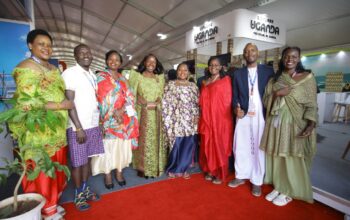
Stanbic Bank and the Dwona Initiative have partnered to empower young girls
by teaching them how to make reusable pads in Budondo, Jinja district.
This initiative follows a media report published by one of the newspapers recently,
where a girl from this very village was featured using an unsafe product made out of
soil.
In a quest to foster sustenance and fight against menstrual poverty, Stanbic Bank and
the Dwona Initiative conducted a whole day training to all girls in candidate and sub
candidate classes at Buyala Primary School on how to make these hygiene materials
for themselves.
With the guidance of the trainers, the girls got hands-on experience in cutting, sewing,
and assembling the reusable pads.
Diana Ondoga, the Stanbic Bank Head of Corporate Social Investment, said that they
are committed to enable girls and young women to learn valuable skills.
“As Stanbic, our purpose is that; Uganda is our home, we drive her growth. We believe
in the potential and our youth, that’s why we are doing everything possible to help them
be healthy and become better people in future.” Ondoga said.
Saulo Nabende, the manager Stanbic Jinja branch said, “The partnership between
Stanbic Bank and Dwona Initiative is a significant step towards addressing the
challenges faced by girls in the Busoga sub-region,”
He added that by empowering youth with knowledge and skills, they can take control of
their menstrual health and hygiene, stay in school, and achieve their full potential.
“This initiative sets a positive precedent for other schools and communities to follow,
ensuring that no girl has to miss school due to lack of access to sanitary pads.”
Donita Turiho, the programs lead at Dwona Initiative, emphasized the importance of
involving boys in the training, empowering them with knowledge to support their female
siblings and future partners.
She said boys will soon become fathers and can play a crucial role in promoting
menstrual health and hygiene.
“By training both boys and girls, will break the stigma surrounding menstruation and
create a supportive environment for menstrual health and hygiene. Pupils have always
revealed that some mothers often fail to provide adequate information about
menstruation, leaving them unprepared for this natural phase of life.” She said.
The girls beamed with pride as they showcased their finished products, hailed Stanbic
Bank for choosing their school for this life changing initiative and also pledged to use
the skills for learnt to save their parents from the monthly cost of buying pads.
Last month, the bank donated sanitary towels worth 10 million Uganda shillings to nine
primary schools under the stewardship of Kampala Capital City Authority to enable
some primary seven (P.7) pupils study better ahead of their first national examinations.
The schools include St Paul Nsambya 49, Kasanga P/S 64, Railway P/S 120, Bukasa
P/S 59, Nsambya police children school 150, Kawempe COU 60, St Jude Naguru 68,
Kawempe Muslim School 45, Mpererwe P/S 115.