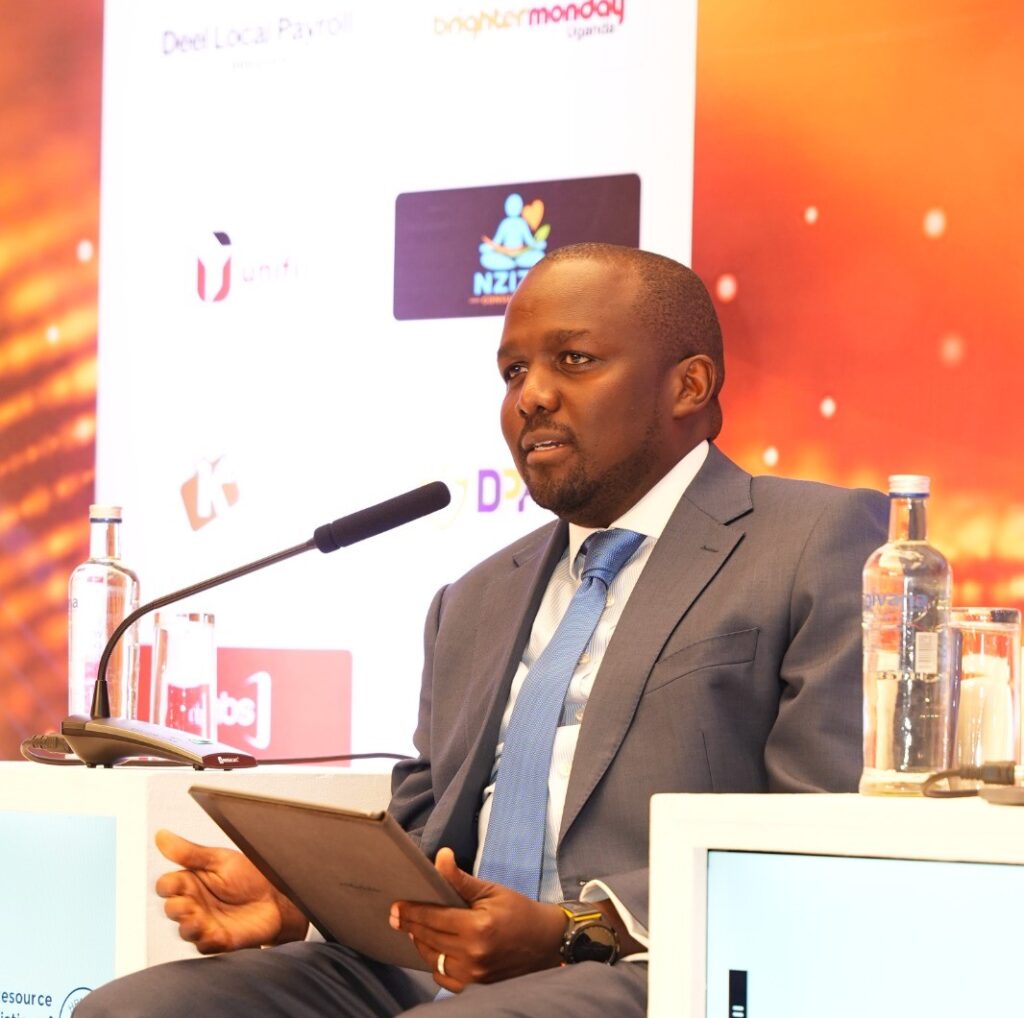
Employers can no longer treat staff benefits as a discretionary cost to be trimmed when times are hard, Emmanuel Mwaka, chief executive of ICEA LION Life Assurance, has warned, arguing that new employment requirements have turned worker protection into a balance-sheet obligation.
Mwaka was speaking on November 12 at the Kampala Serena Hotel during the Third Annual Conference of the Human Resource Managers’ Association of Uganda (HRMAU), on the closing panel, “Law, Labour and the Future: A Policy Conversation on the Changing Workplace.”
Moderated by HRMAU Secretary General Evelyn Lwanga Ssematimba, the session examined how employment law and changing work arrangements are reshaping the workplace. He shared the platform with Patson Arinaitwe, senior partner at Signum Advocates, and Stephen Asiimwe, chief executive of the Private Sector Foundation Uganda (PSFU).
The conference, themed “People-Centred Leadership and Technology for Sustainable Growth,” placed worker welfare at the centre of business strategy. For Mwaka, that meant moving employee protection out of the human-resource department and into the boardroom.
“Changes in employment legislation have significant financial implications for businesses,” he said. “Requirements relating to employee benefits, leave and workplace protection mean that employers must move beyond informal interpretations of the law and account for these obligations in their financial planning. These responsibilities must be reflected on the balance sheet.”
Extended sick leave and severance pay require employers to plan ahead, he said, creating room for insurers to help businesses manage those liabilities through more predictable arrangements.
But insurance, he insisted, should be arranged before a crisis, not after it. “Insurance is something employers should consider before a problem arises, not after,” he said. “As employment obligations evolve, businesses need to rethink how they manage employee-related risks and ensure they have appropriate protection in place.”
Mwaka proposed a four-part employee safety net: life insurance for employees’ families, medical and critical illness cover, income protection when employees cannot work, and retirement savings beyond the statutory minimum.
“Employees may have jobs, but that does not necessarily mean they have financial security,” he said. “Many remain concerned about what would happen to their families if they were no longer around or became unable to work. Employers must therefore look beyond the workplace and consider the financial well-being of employees and the families who depend on them.”
He warned against a one-size-fits-all approach. “Small businesses, gig workers and organizations with limited budgets face different realities. Insurance solutions must recognize these differences and provide flexible structures that allow more workers to access meaningful protection,” he said.
Mr Arinaitwe, who earlier presented a session on emerging legal and policy trends shaping the workplace, said policies alone do not produce decent work. “Achieving decent work standards goes beyond having policies in place. It requires continuous management training and learning to ensure leaders can effectively respond to evolving workplace dynamics,” he said.
Mr. Asiimwe brought the employer’s bottom line into the room. “Our policy approach should focus on creating enablers, not suffocators,” he said. “We need labour laws and workplace reforms that encourage innovation, fair treatment and social protection while supporting economic growth.”
His intervention captured the debate’s central tension: stronger protection costs money, but weak protection costs productivity, trust and, eventually, stability. The answer was not to choose between people and profit, but to design protection that smaller employers can afford and workers can use.
Ms Ssematimba took the argument from compliance to lived experience. “A policy’s value is revealed when someone needs to rely on it,” she said. An insurance policy is only the starting point; the real questions are what it covers, where the gaps are and how far protection extends to the families employees support.
Mwaka returned to the same theme. “Compliance sets the minimum standard, but employers must go further by building protection, trust and good governance around their people,” he said. “Employee welfare should not stop with the individual; businesses must also recognize the families and dependents whose well-being is connected to their employees.”
For Uganda’s employers, the message was blunt: in a labour market where a job does not always guarantee security, the most important balance-sheet line may be the one that protects the people behind it.