By Simon Wokorach
A recent drive into the plantation, the largest portion of lands in the north gate of the scheme from the upper belt is reclaimed by the swampy thorny bushes whereas the south to the lower surrounding areas had a handful of farmers engaged in the rice production.
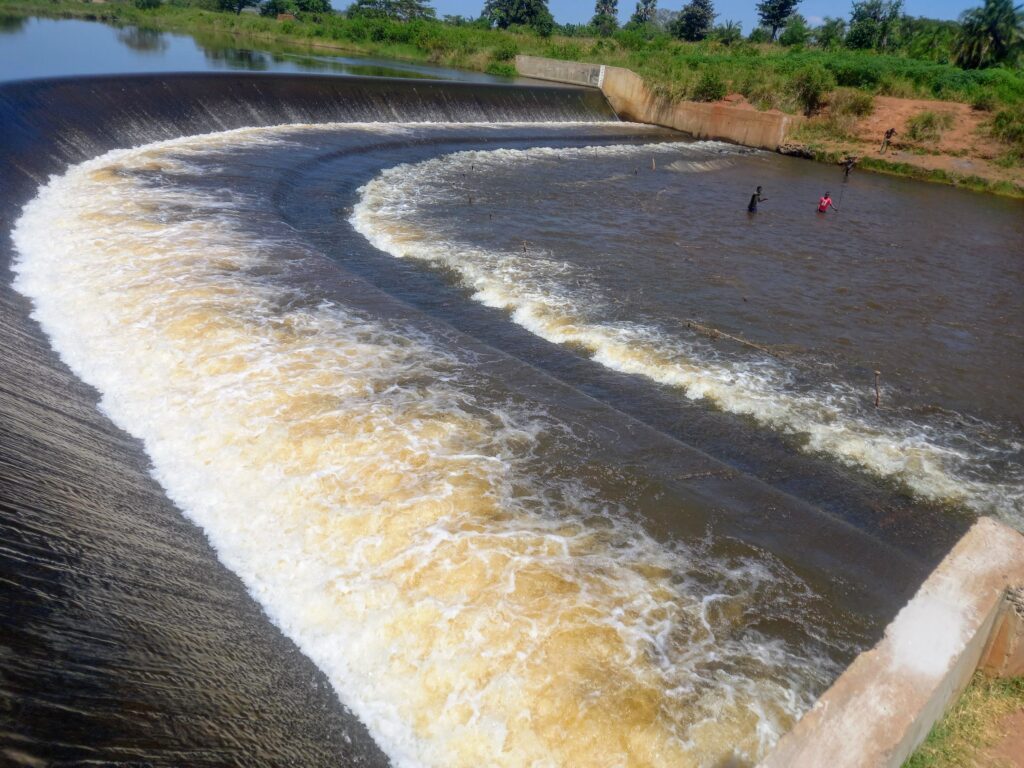
The 32-billion-shillings African Development Bank credited Tochi Irrigation scheme was launched jointly in 2018 by the Ministry of Agriculture, Fisheries and Animal Husbandry, Water and Environment.
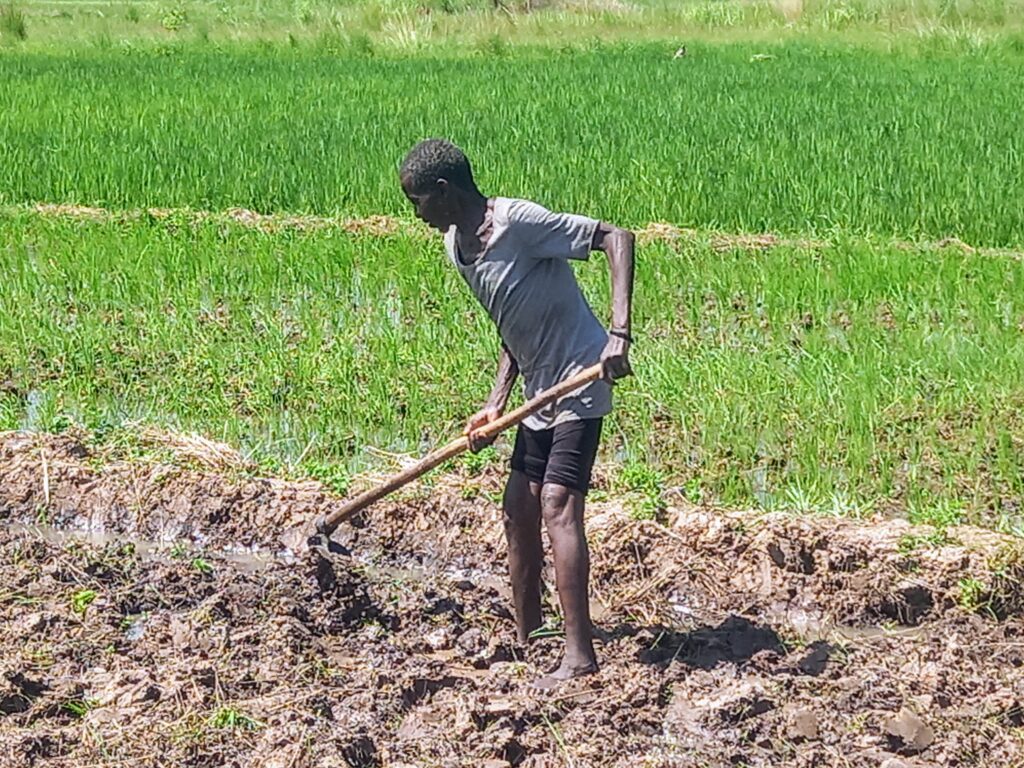
The multibillion project which aimed at annual production of 70 tons of rice grains has failed to realize its maximum potential as farmlands get invaded by rats and feed on the rice crops.
Established within the wetlands few kilometers off the Minakulu trading Centre to Oyam district headquarters, the scheme is meant to provide livelihoods support to 1224 small holder farmers.
Records from Oyam district entomology department revealed that 90% of the rice crops in the scheme was destroyed by the invasive rats in the year 2023 from the first season of farming.
The report further notes that the losses incurred by the farmers in the same period is projected at 1.4 billion shillings which is equivalent to 10,000 bags of rice lost in the season.
“Under the natural ecosystem, snakes which could feed on the rodents to reduce their population are going extinct due to climate change and the natural setup have changed” the reports read in part.
Immersed between the losses and gains is Ray Okello, the elderly farmers in the plantation who spends sleepless nights fending his farmland from the invasive horror of rodents.
Okello’s portion of rice crops is no different from others in the scheme which are under threat by the rats which have occupied the farm since 2021 as farmers count losses in the production.
Battling for the gains, Okello habitually leaves home in the morning for farming but in the evening, he prepares for yet another battle with the rats on his farms where he spends sleepless nights.
The initial harvest ignited hope before tragedy, from his plot of land, equivalent to an acre, Okello harvested 30 bags of rice, though he sold them to middlemen men, he garnered 2.5 million shillings.
“I started building my permanent home with the money I got from the first season of the harvest (2020) but what came later is the rats that destroyed all my crops in the second season “Okello recounts.
Like hundreds of others, harvesting stands in the crossroads between the losses and the gains “there was a day I killed them (rats), they were full of a basin when I collected” Okello told this Publication.
Besides beating empty tins to scare away rats, Okello would make sure he burns tyres but experts say though the local initiative works, it has a harmful impact on both the environment and other creatures.
The practice of burning tyres is widely used around home to help repel snakes, in regards, experts urge that the snakes which could act like natural controllers of the environment will have to migrate.
Why rats invaded the rice scheme
Hundreds of plots of land were abandoned due to the 2021 floods’ disasters that submerged the scheme, the swamp has now grown back to bushes which provide breeding places for the rats.
Though experts believe that the natural ecological system could have been controlled by the predators, the local farmers are skeptical on the relationship between the species and humans around the farms.
The Oyam district senior commercial officer Alex Enon revealed that 654 acres within the plantation remained idle which provides habitat for the rodents as they target crops in the gardens to feed on.
“I have never seen these rats before in my life; they attack gardens like swarms of locusts and can eat the whole plot in just one night” the district commercial officer Mr. Enon said during a recent interview.
“The higher the number of rats in the area, the more cereal food loss in that area but when there is a good balance of predators and preys, the loss is minimum” The Ugandan Herpetologist Dr. Mathias.
Farmers abandoned the scheme
Whereas farmers like Okello have proven their resilience in the plantation, hundred others have abandoned their plots, citing uncontrollable pests and high cost of the irrigated water.
While the Uganda national irrigation policy has highlighted little attention and technological investment and development put toward irrigation, more are yet required for supporting the local farmers in Lango.
The rainfed agriculture has progressively been constrained by droughts and floods but the Country has one of the irrigation potentials in the World with 15% of her surface area covered by fresh water.
The Country’s cultivated area under irrigation remains low within East Africa which stands at only 0.5%, Tanzania tops with 3.6%, Kenya and Burundi share fate at 2% and 1.6% respectively.
As recently as December 20, 2023, Geoffrey Akwar, one of the local farmers had hired casual laborers to fetch water from the dam to nourish his one-acre rice garden within the irrigated farmlands.
His portion of land does not receive water from the dam, thus everyday he has to hire people to water his crops, on the other hand, like others, he remains in the garden in the evening to battle rats.
Neighboring his garden, several plots were abandoned where the rats would hide as they locate crops “I lost everything here due to rats” Stella Obonyo, a farmer who gave up on farming.
Stella who invested 3 million in the scheme has lost hope and abandoned farming as she harvested nothing, besides, Obonyo said, she could not afford to pay the 100,000 water users fee levied on them.
“The water hasn’t reached my garden for two years but I don’t know why the implementers are selectively directing water to peoples’ farms” She asked.
But the Public Relations Officer for the Ministry of Water and Environment Brenda Akao noted that the contribution is part of the sustainability plan for the project.
To her, the money collected is to finance the maintenance of the scheme which includes cleaning the canals, slashing to control pests, replacing vandalized assets and paying wages for management staff.
How cropping calendar is working to contain rats
While the rats are reportedly becoming resistant to a number of chemicals, the introduction of a cropping calendar to the farmers is reviving hope for a natural control of the wild rats.
The cropping calendar according to the Food Agricultural Organization is a tool that provides timely information about seeds to promote local crop production.
It contains information on planting, sowing, harvesting periods of locally adapted crops in specific agro-ecological zones, it also provides information on the sowing rates of seed and planting material.
The new model according to the management of irrigation has helped the affected farmers to take appropriate decisions on crops and their planting periods in response to the agro-ecological challenges.
Besides the model, according to Enon, the government through the National Agricultural Research Organization is researching rice seeds which attracts less interest of the rats to feed on.
In the new arrangement, all plots of lands in the designated areas are ploughed at the same period of time, crops are also planted the same and harvested at once, hence, it destroys the hideouts of the rats.
“We want to eliminate the use of chemicals in fighting these rats because of its impact on the environment and the risk on the grains, we tested this and it’s working” Enon further noted.
The records at Tochi Irrigation Cooperative indicate that the introduction of a cropping calendar in the second season of 2023 in part of the scheme moved the production from 10 tons of rice to 45 tons.
The scheme is projected to produce 70 tons of rice in every season of production, Geoffrey Otim, the General Secretary of Tochi Cooperative is hopeful of meeting the target once the pests are eliminated.
Cropping calendar faces of with new challenges
The contour of land within the scheme embedded in the swampy area proved resistant to ‘hand hoes’, at its initial planning, the government was to aid the process of mechanized production in the scheme.
Whereas the model is worth taking, the farmers in their advanced ages will have to struggle to cultivate, for farmers like Okello, using hand hoe to dig would mean, taking more months for opening the land.
“I always miss planting in the first season of the rain because sometimes I have to take 5 months in preparing the land which takes me up to the second season” Mr. Okello told this Publication.
The lack of mechanization has remained critical to whether most farmers who do not have capital to hire cheap labor to open land shall fit in the production of the group farming currently being adopted.
“They (management of the irrigation) bring us tractors to hire at 180,000 shillings, paying for irrigated water is 100,000 shillings, I abandoned my plot because I didn’t have money” Obonyo narrates.
According to the district commercial officer, the government was to procure 3 tractors for supporting the farmers in opening up the land at a subsidized cost but the tractors have never been delivered.
“The farmers are using hand hoes to open the land which takes them very long to complete, they can’t catch up with the planting season but we hope the ministry of agriculture addresses that” Enon said.
Because of the inability of the farmers to open up land according to him, a vast area with plots of lands allocated have been abandoned where rats are harboring in order to breed.
Snakes for ecological natural control?
The mystery that condemned the snakes in the Old Testament continued to sustain a wild co-existence between the snakes and humans but experts argue that snakes are the natural control agents of an area.
The Ugandan Herpetologist Dr. Mathias Behangana observes that snakes are in the group of reptiles, asserting that, 90% of the reptiles are carnivorous, they feed on other organisms inclining rodents.
Dr. Mathias explained that conservation of snakes just like other species in the amphibian family would mean, they can naturally eliminate both pests and parasites from a given environment.
Some of the organisms like rodents feed on the cereal crops, hence, snakes become agents of the natural control to contain their outburst in a particular environment as he further explained.
Besides controlling the invasive animal prey species like rats in a given environment, Dr. Mathias noted that snake venoms are key ingredients for manufacturing chemicals to fight viral diseases.
“Those venoms once extracted well can manage viral conditions and scientists are trying to discover drugs from them so let’s conserve them, who knows where drugs would come from” Dr. Mathias.
On instances where snake bites occur, Dr. Mathias observed that, at that time, the snake would be on the lookout for its prey (food) so, whatever crosses its territory becomes a victim.
“About 90% of the snakes in the Country are nonvenomous but even the venomous ones are peaceful if not threatened and where you see snake bites, it’s accidental because they only use venoms to paralyze their prey and, in this case, humans aren’t the preys they would be looking for” He further explained.
But like snakes, Dr. Mathias further revealed that other endangered rare animal species like frogs and chameleons potentially help to fight malaria disease.
“In the areas of wetlands, frogs can disrupt the lifespan of mosquitoes, they feed on those larvae so why don’t we take advantage of conserving these animals as a Country? Dr. Mathias asked.
Dr. Ivan Kaddu, another Herpetologist with Herp Fauna Uganda also noted that snakes, especially the nonvenomous ones can offer good ecological services to the environment, like his counterpart, he said, in an area infested with pests, snakes will bring balance.
According to him, each snake can feed on a minimum of 3 rats per week, in an area like Tochi which is infested with rodents, Dr. Kaddu argues that species of nonvenomous snakes can be introduced to counter the threats of such invasion especially on food crops.
Once snakes are introduced in a place, it may not have an immediate impact because of the slow rate of their multiplication, each snake can produce 30 young ones per year and for their numbers to correspond to the preys, the results can show in about a year as for a case of Tochi irrigation as he noted.
“I think Uganda Wildlife Authority should begin relocating such predators to the areas with food crops under threat, this will eliminate chemical use in the environment because when you spray an environment, you are doing a non-context selective, other organisms will go extinct” Dr. Kaddu added.
Why snakes remain danger to farmers
Between July and August 2020, Makerere University School of Public Health conducted research from 6 study districts of Gulu, Arua, Mubende, Mbale, Kamuli and Nakapiripirit on the snakebite incidences from the 29 health facilities.
The statistics generated from the hospitals and health facilities in the study districts show that, from a total of 736,580 patients that sought medical attention from those selected districts in 2019, 536 of them were treated from snakebites.
In the report, the most affected districts were Gulu and Nakapiripirit both accounting for 104 cases of every 100,000 persons and Nakapiripirit with 84 patients, 48 % of the patients were managed from regional referral hospitals while 20% of them were treated from the lower health facilities.
The reports further established that, globally, 2.7 million people suffer from snakebites annually while 125,000 of them die with the verminous complications in Sub-Saharan Africa and Asia.
The records from Herps Fauna Foundation, a conservation organization, revealed that ,250 patients were registered annually but 25 more cases were recorded from Lira and Lweero from December 2023 and January 2024.
According to Dr. Kaddu, of the 171 species of snakes in the Country, only 5% are poisonous saying, snakes can not only bring balance to the environment but are reagents for treating cancerous infections especially breast cancers and other viral infections.
He noted that, even the non-poisonous snakes at times can bite once they are disturbed, though their bites are harmless, the victims have to get treated for other diseases that might likely come from rats since the snakes interact with rats, their fangs can carry on germs from rats to humans, not venoms.
“About 60% of Ugandans seek treatments for snakebites from the herbalists but where you see those people recovering, it’s because the snakes weren’t nonpoisonous and we need to sanitize our people that not all snakes are bad but lets us know how to live with them” Dr Kaddu retreated.
What to do when you see a snake
Conservationists like Dr. Kaddu argue that, once the World’s snakes are eliminated, the population of inessive prey animals like rodents or mice will uncontrollably burst on earth and disrupt food production.
Primarily, snakes are peaceful creatures until they are threatened, to Dr. Kaddu, once a snake appears, and to avoid confrontation, one can keep a distance of 5 to 15 meters away, in this case, the snake will find itself moving away from the place peacefully.
“Snake handling requires certain skills that only a few conservationists know but in the farm like that, it can be challenging but the best to do is keep away and avoid confrontation” Dr. Kaddu reiterated.
Although snakes are regarded as farmers’ best friends, farmers like Okello have maintained his fear” They haven’t killed anyone here but they are dangerous, yes kill those we find” farmer Okello.